

Change

Experience more coverage with T-Mobile Starlink satellite service

Same phone. More coverage.

No setup. No stress. No pointing at the sky.

T-Mobile is the first and only U.S. wireless provider to keep you connected in places never thought possible, thanks to the world’s largest satellite-to-cell constellation in partnership with Starlink.

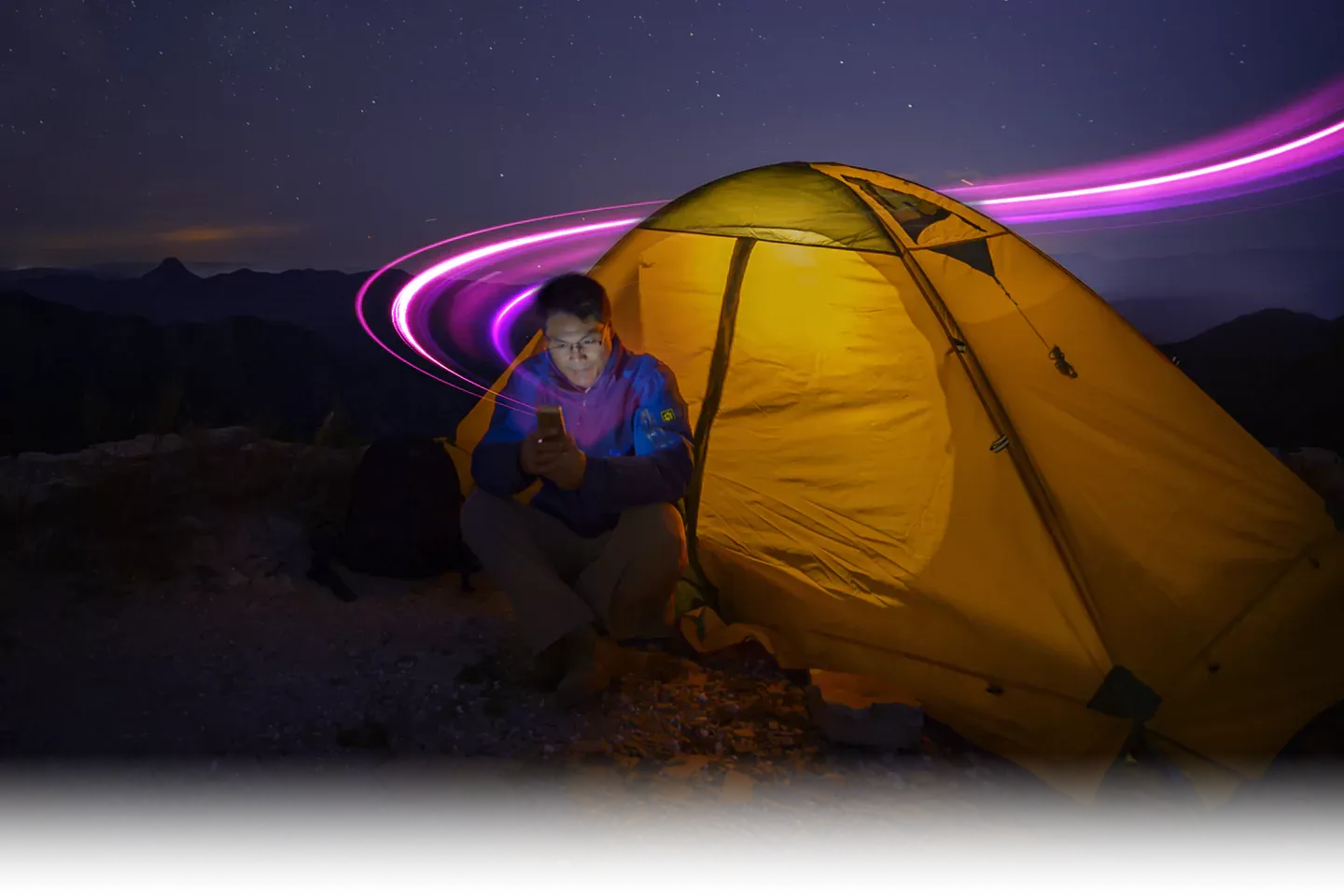
Happer camper illuminated by his cellphone under a stary night sky. He is so happy with his satellite service that he can do anything, anywhere on his phone.

​​How does it work? Just look up.​

Smiling girl with a beanie and cup of hot cocoa using her phone.

How does your phone connect with the satellites?

The T-Mobile satellites are constantly in motion, but don’t worry—your phone disconnects and reconnects to the next satellite automatically. 

Once connected, you’ll see a satellite icon in the upper right of your screen (this may look different depending on your device).


Hiking friends taking a selfie while in the mountians.

No setup needed.

T-Mobile Starlink requires no setup or adjusted settings. Simply text as you normally would and your phone will work as usual.

There might be small gaps in your service when moving from one satellite to another, but your phone will connect to another satellite automatically once it's in range.

Man getting some internet time while up in the mountians.

How do you get the best service possible?

No need to point your phone at the sky to grab the best signal. Having a clear, unobstructed view will give you the best service possible.

You may face more interruptions in dense forests or valleys, and there are certain government-regulated areas where we can’t provide satellite services. But don’t worry, your phone will be working to get you a signal as soon as it’s possible again.

T-Mobile satellite service pricing

T-Satellite pricing varies depending on the T-Mobile plan you already have. For some T-Mobile customers, you don’t need to do anything—T-Satellite is already included in your plan.

  • Experience Beyond & Go5G Next customers: T-Satellite is included in your plan.
  • Experience More customers that were part of the T-Mobile Starlink beta: T-Satellite is included in your plan through the end of the year.
  • All other T-Mobile customers: Add T-Satellite for a limited time at $10/month (a savings of $5/mo.) under ‘Manage Data & Add-Ons' in your account. 
  • Not a T-Mobile customer? Get T-Satellite for $10/mo. (a savings of $5/mo.) by calling today or visiting a T-Mobile store.

Our goal? To end dead zones.

There are over 500,000 square miles in the U.S. not served by any wireless company’s cell towers—that’s almost twice the size of Texas. Unlike our competitors, we’ve found the solution to these dead zones.

Satellite Icon

Satellites

  • T-Satellite already has over 650 satellites—that’s enough to make a new constellation.
  • Verizon, on the other hand, has fewer than 10.
  • AT&T? None.
Devices icon

Devices

  • T-Satellite works with over 60 phones.
  • Verizon can only support a few Androids.
  • AT&T? Nothing to work with your phone. They’re still testing.
experience icon

Experience

  • T-Satellite automatically connects—even while your phone is in your pocket.
  • With Verizon, you’ll be holding up your phone, waiting for a signal…
  • AT&T? You guessed it. No signal.

Frequently asked questions

How is T-Mobile's Starlink service different from traditional cellular and other satellite services?

T-Mobile’s Starlink service is designed to fill in cellular dead zones by using SpaceX’s Starlink satellites, unlike traditional towers that can’t always reach remote or rural areas. 

Unlike older satellite services, which often suffer from high latency and limited capacity, Starlink’s low Earth orbit satellites provide a fast and more reliable connection. This makes T-Satellite unique from both traditional cellular networks, which require dense tower coverage, and legacy satellite services, which often struggle with slow speeds and inconsistent performance.

What can you actually do with the T-Mobile Starlink service?

The T-Mobile Starlink service is meant primarily for text messaging in areas where traditional cellular coverage is unavailable. It allows users to send and receive SMS messages, ensuring connectivity for emergencies or basic communication when outside of coverage areas. 

How fast is the T-Mobile Starlink service, and can I use it for streaming or video calls?

Currently, T-Mobile’s Starlink service is not optimized for high-bandwidth activities such as streaming or video conferencing. Currently, we’re focused on providing SMS messaging services when you’re traveling through a rural, wilderness, or offshore area without traditional coverage.

What kind of coverage can I expect from this service?

The goal of T-Mobile’s Starlink partnership is to cover the dead zones where standard cellular towers can’t reach. That means service will extend to rural areas, national parks, highways, remote coastlines, and other locations where people often experience signal loss. 

At first, coverage will be limited to SMS messaging, but the satellites are being designed to work with standard smartphones without requiring special equipment. As more Starlink satellites with direct-to-cell capability go live, the coverage area and reliability will continue to expand significantly.

Is this T-Mobile's Starlink service the same as the regular Starlink internet service?

Not exactly. Starlink residential and RV internet services are designed to deliver high-speed broadband via satellite dishes and user terminals, supporting streaming, gaming, and full online use. T-Mobile’s Starlink service, however, focuses on direct-to-cell connectivity—allowing regular smartphones to send texts (and eventually make calls) in places without cellular service.